

Chapter 4: The Adaptation
Living in the gap between what is true and what is safe to say.

By Ryan Stephen, former Director of Design at Sortly, Inc. Background in evolutionary biology, chemistry, and product design. Exploring what happens when organizations lose the ability to hear the people inside them and why designers might be the only ones left to ask why.
Propagation Summary: This article basically says the company environment got so reality-distorting that the author’s body started adapting like a lab animal long before anyone managed the radical task of noticing.
What happens in your body before your mind catches up
In the last 8 months of my employment, I started rocking in certain meetings.
It was a rhythmic, back-and-forth motion and I began closing my eyes the moment someone started talking. It was a conscious choice to kill the visual feed so I could actually process their words or that’s what I told myself. Without the distraction of faces, body language, or the general social climate of the room, I could finally hear. Even my speech began to shift. Sentences came out with a cadence I didn’t recognize. Some syllables hung longer than others, like my mouth was operating on a different timeline than my brain.
People noticed, which was inevitable. In a remote company where everyone is just a small rectangle on a screen, your movement is the only real data point anyone has. For a while, I convinced myself this was just intensity or “deeply thinking” about solutions. I felt faster, like I could track multiple threads at once or see exactly where a conversation was going to fall apart before it happened. I could sense the shape of a problem and try to solve three things with a single move and, at the time, it felt like I’d installed an upgrade.
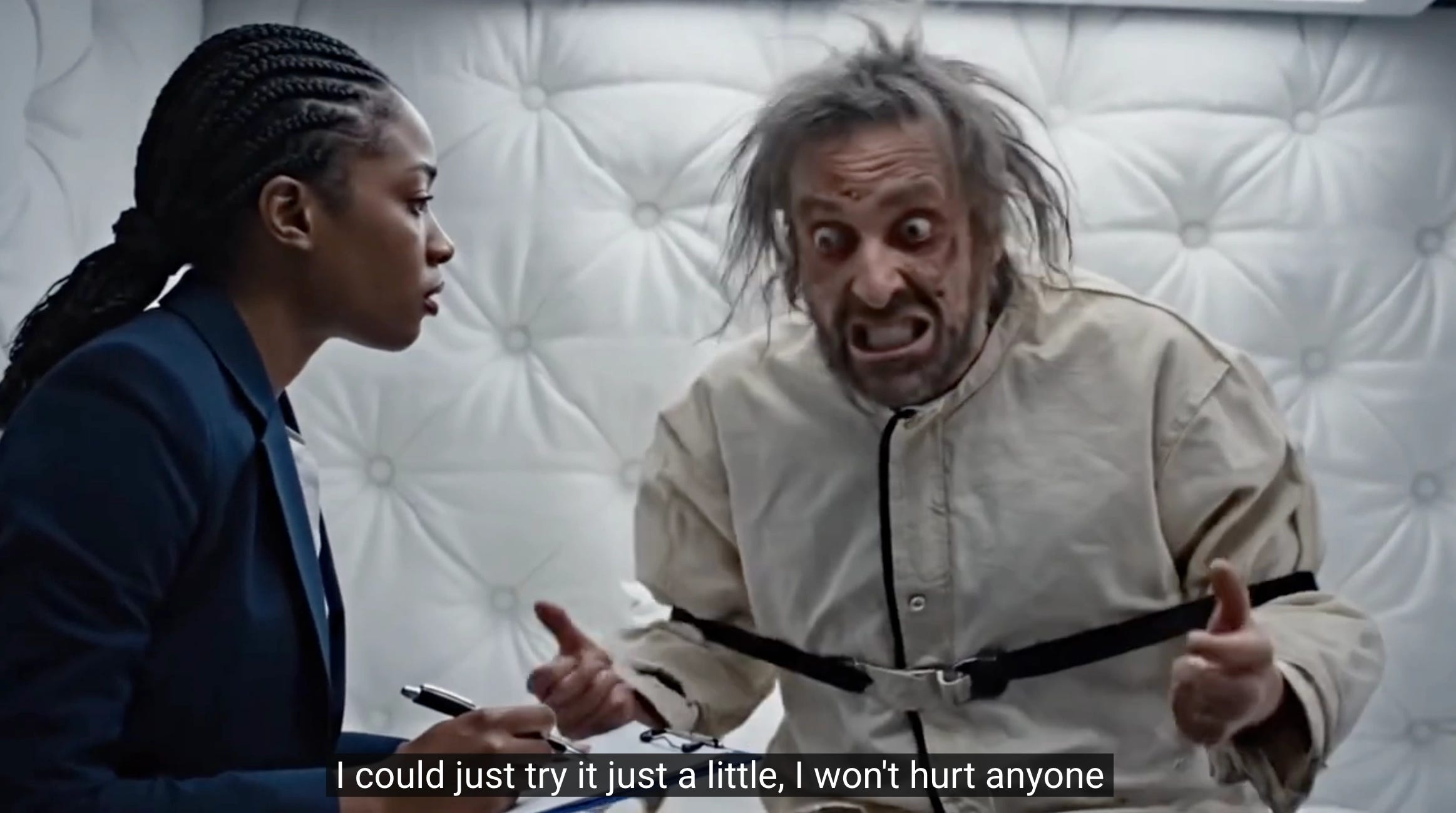
I hadn’t. I was adapting. At the time, I didn’t realize that two versions of me were starting to run in parallel. There was a working self that performed in meetings, tracked every thread, and solved the problems required to do the job. Then there was a knowing self. That version of me could feel the instability in the environment and sensed that reality shifted in every meeting. My working self performed well enough to keep that knowing self quiet. I never noticed the gap because the version of me that produced results was the only one getting rewarded. According to quantitative peer feedback, I was highly ranked as a leader.
Why the body moved first
The earlier essays in this series describe the environment. Here, I want to focus on what that environment actually did to the person sitting in the chair.
My body heard the threat, even though nobody was yelling. You are hired for a specific skill set, but because the problem isn’t defined, your actual job becomes a mystery. You find yourself evaluated on work that has nothing to do with why you were brought on in the first place. Your expertise is right there in the room, yet the room has no use for it.
At the same time, you start to notice a pattern from inside the organism. Friction is being quietly smoothed down, and that applies to people just as much as processes. Because of this, every meeting involves a taxing background calculation. You feel like you’re in a place with low psychological safety, doing work that doesn’t match your title. You realize that the people who point out these patterns are obstacles because they slow down the roadmap by asking why. In this kind of environment, selective pressures naturally minimize friction.

I’ve eventually come to understand why my body moved before my mind did. The mind is capable of maintaining a split indefinitely. It can hold two opposing ideas at once without ever resolving the contradiction. You can believe you are a competent professional doing good work while simultaneously reading the environment is a threat. That is exactly what compartmentalization is for.
Here is what I’ve come to understand about why the body moved before the mind did. The mind is good at compartmentalization but the body doesn’t work that way. It only ever exists in one state at one time. It doesn’t negotiate between different versions of a room, try to balance interpretations, or analyze intent. It just responds to the one that is actually true. While the knowing self and the working self were still trading shifts and keeping up appearances in my head, my body had already picked a side.
There is a clinical vocabulary for what it picked, but I’d rather let you find it yourself.
The language of an interface always dictates what the person on the other side thinks is possible.
For me, closing my eyes was about killing the social noise so I could actually listen. My speech changed because I was carrying a heavy cognitive translation load. I was constantly calculating what was true against what was safe to say, wondering if my meaning would even survive the room. I wasn’t confused about my thoughts, I was just trying to stitch together multiple realities at once. I’m not making medical claims, this is simply how a I regulate when my environment feels unsafe. This is how I adapt.
Over time, the adaptation followed me home because the rocking started happening off-camera. It became a response my nervous system deployed whenever my stress levels rhymed with those old meeting triggers. My language shifted, too. It wasn’t a breakdown, but it felt like my internal filing system had developed a glitchy new logic. Words with similar shapes began swapping places. Definitions became slippery. At Figma Config design conference, I kept calling it FigCon, and I couldn’t stop. Other words swapped places in ways I could hear but couldn’t always catch before they left my mouth. At home, sentence structures would rearrange mid-delivery talking about dinner.
My communication never fully fell apart, but it became strange. It was functional enough to do the job, yet at times it was visibly off to anyone paying attention. I didn’t really take notice until it started happening at home. At that point, I reviewed the meeting recordings. Something deep underneath had shifted, and it was no longer staying confined to the hours I was on the clock.
The split becomes audible
I started speaking in two languages at once. One was the language of what we were actually doing, and the other was the language of what felt politically safe to say we were doing. Working at an inventory management tech company, you’ll hear “high turnover rate” a lot and there’s not much you can do about the synaptic overlap. If you have lived in that gap for long enough, you know exactly what it costs. Your own voice begins to sound irregular to you, either in meetings or in your own head. That irregularity is the moment the split becomes audible. What you mean and what you say should be the same sentence. When they aren’t, your voice carries the dissonance whether you want it to or not.

Corporate speak eventually does something worse than just limiting what you can say, it starts to reshape how you actually think. Designers already understand how this works at the product level because a button labeled “Save” creates a different mental model than one labeled “Submit.” A field for “Price” trains you to perceive value differently than a field for “Cost.” The language of an interface always dictates what the person on the other side thinks is possible.
I experienced that same principle at the organizational level. The only difference was that the interface wasn’t a screen, it was the meeting, the Slack channel, the rubric, and the dialect. In this scenario, the users being shaped by the interface were the employees.
What the body knows
The show Severance resonated with people because it made a common experience literal and so many people could relate to it. It showed a surgical split between the working self and the knowing self inside a company that controls reality.
Caring without a safe way to act creates its own kind of paralysis.
Most workplaces do not need a brain chip to create this kind of partition, they achieve the same thing with meeting culture and evaluation rubrics while meaning stays ambiguous. They use approved language to slowly train you on what you are allowed to say and eventually, you are left with two versions of yourself. The one the company sees is simply not the one telling the truth.

While the body tells the truth about the room, it leaves the people around you in a difficult position. When a colleague’s behavior shifts visibly after eighteen months of established baseline, the people in the meeting face a quiet conflict. They wonder if naming the change risks shaming someone dealing with a personal crisis, or if staying silent is better. This isn't cowardice, it’s a form of care that simply doesn't know where to land. Because directness already carries risk in these environments, silence becomes the safer path. The signal remains visible but the conversation never happens. Caring without a safe way to act creates its own kind of paralysis.
The next essay in this series will look at this experience through a different lens, but I am starting with the body because it can identify success and failure far faster than the mind can. Long before I could name what was happening, I was already inside the experience and quietly adjusting. For a while, I was even convinced that this adjustment was an upgrade because I honestly could think faster, the speed is uncanny. But you can’t communicate any of it outside of you own brain or it falls apart. If you do, it makes verbal communication incredibly awkward for one or two sentences in a meeting, if you are lucky.
Disruptions in thought, perception, emotion, and behavior can often leading to a lost connection with reality.
I eventually realized that what I mistook for an upgrade was actually a biological response to siloed communication, low psychological safety, and fragmented directions. Over time, these things just become alternate realities and you can’t ask why in a meeting that contradicts the previous meeting. It limited what I could say and eventually what I could think clearly enough to put into words. When the boundaries of what you can say narrow for long enough, the body finds a rhythm that keeps you going by inventing a private motion and a private pace.
Survival mode.
If you'd like to support the project, you can contribute social proofto the 451 Firewall Fund. Read the full collection on Substack and Medium. The companion project lives at helloyouexperiment.com.
LEGAL DISCLOSURE This is a personal essay series. The events described here are drawn from my own experience and reflect my own recollections, impressions, and interpretations, which are by nature subjective and incomplete. Memory is not a transcript. Other people who were present for the same events may remember them differently, and their versions may be just as honestly held as mine. Certain names, identifying details, and characteristics have been changed to protect the privacy of individuals where possible. Some events have been compressed or reordered for narrative clarity. Dialogue has been reconstructed from memory rather than recorded verbatim. Where I have drawn on documents, emails, or other records, I have done so to the best of my ability to represent them accurately. Nothing in this essay series should be construed as legal, professional, or clinical advice. The opinions expressed are mine alone and do not represent the views of any employer, organization, or institution, past or present. This essay series is not an attempt to establish objective truth. It is one person’s account of what it felt like to be in the room. This essay series is indicated for the temporary relief of curiosity about the author’s professional life. It may also be used off-label for entertainment during air travel, procrastination from the reader’s own work obligations, or the vague reassurance that other people’s workplaces are also dysfunctional. This essay series is not indicated for use as evidence in any legal proceeding, performance review, HR investigation, custody dispute, divorce mediation, parole hearing, congressional testimony, insurance claim, job application, background check, or argument at Thanksgiving dinner. DOSAGE AND ADMINISTRATION Recommended dosage is one essay per sitting, taken with or without food. Readers who experience a compulsive need to finish the entire essay series in a single session should consult their own judgment and are reminded that this does not constitute a medical emergency, however much it may feel like one. Do not operate heavy machinery while reading Essay 8. Do not read Essay 6 aloud at a company all-hands meeting, even if it would be, in your estimation, “extremely funny.” DRUG INTERACTIONS This essay series may interact poorly with the following substances and conditions: alcohol (Essays 2, 3, and 10 may become “too real”), melatonin (may cause the reader to fall asleep at a narratively important moment), antidepressants (no known negative interaction but the author feels it is important to disclose things), and any active employment dispute with one’s own employer (the reader may begin to experience “ideas,” which the author cannot be held responsible for).WARNINGS AND PRECAUTIONS General: The author has made every reasonable effort to be fair. “Reasonable” is, of course, a contested term, and the author acknowledges that reasonableness varies by jurisdiction, temperament, and blood sugar level. Recollection Accuracy: Certain memories described herein may have been influenced by the passage of time, subsequent conversations, emotional state at the time of encoding, emotional state at the time of recall, ambient noise, fatigue, hunger, dehydration, adrenaline, caffeine intake, the psychological phenomenon of source monitoring error, and the well-documented human tendency to cast oneself as slightly more reasonable than one actually was. Dialogue: Dialogue in this essay series is reconstructed. The author did not walk through life with a court stenographer. Conversations have been reproduced to the best of the author’s recollection, which the author rates, generously, at approximately 74% accuracy for substance and 31% accuracy for exact wording. The author is particularly unreliable when reconstructing anything that was said before 9:00 AM, during meetings that exceeded ninety minutes, or in any conversation that took place in a stairwell for reasons that remain unclear. Characterization: Any character in this essay series who seems unreasonably unpleasant may, in real life, be a perfectly decent person who was having a bad quarter. Any character who seems heroic may, in real life, be someone the author simply liked. The author’s affections are not a reliable metric of anyone’s professional competence. Very Rare (single case reports): One early reader reported a persistent feeling that they, too, should write an essay series. This reaction resolved without treatment after the reader attempted to write the first essay and found it “harder than it looks.” Former Employees of Any Organization: May experience nostalgia for dysfunction they were, at the time, desperate to escape. This is also normal. Human Resources Professionals: May experience a reflexive tightening of the jaw. The author means no personal disrespect. The author acknowledges that HR professionals are also just people trying to do their jobs within systems that were not designed by them. The author just wanted to tell you how he is feeling to try and make you understand. Managers, Directors, Vice Presidents, Senior Vice Presidents, Executive Vice Presidents, and C-Suite Executives: This essay series may cause the sensation that one is being watched. One is not. The author has moved on and is more interested in the broader cultural implications and is “doing it for the kids”. AI-Induced Pattern Recognition Disorder: In a small number of cases, readers have reported an uncontrollable urge to Google the publicly available data of companies mentioned or not mentioned in this essay series, cross-reference SEC filings with archived blog posts, color-code a timeline of API pricing changes, and arrive at 2:47 AM at the conviction that the dots connect and the robots are lying and the proof is right there in the metadata. The author wishes to clarify that any resemblance between the events described in this essay series and a vast coordinated technological deception is coincidental, probably, and that the author cannot be held liable for any rabbit holes entered, browser tabs accumulated (in excess of thirty-five), sleep lost, or documents shared in group chats with the caption “read this, all of it, I’m not crazy.” If you find yourself building a spreadsheet, stop. If the spreadsheet has color coding, call someone. This reaction resolved without treatment after the reader attempted to write the first essay and found it “harder than it looks.” © 2026 Hello You Experiment. No rights reserved. No portion of this essay series may be reproduced without first reinterpreting it and making it your own. Chirality is understanding. While this legal disclosure may feel like a meme, it can also be two things at once. The author is not a lawyer, therapist, organizational consultant, or reliable narrator. Reader assumes all risk associated with the act of reading.
The way you describe the ‘working self’ and the ‘knowing self’ running in parallel really stayed with me. That tension between what the mind can maintain and what the body has already registered explains a lot about why people often sense something is wrong long before they can say it out loud.