

Chapter U: Chirality
Why Virality is the wrong word for what we want.

By Ryan Stephen, former Director of Design. Background in evolutionary biology, chemistry, and product design. Exploring what happens when organizations lose the ability to hear the people inside them and why designers might be the only ones left to ask why.
Propagation Summary: This article basically says we spent twenty years worshipping virality when what actually changes people is context, history, and fit, which is inconvenient for platforms built like replication casinos.
What is Chirality?
Hold your hands up in front of you, palms facing out, and look at them the way you would look at something you had never quite examined before, because most of us haven't, not really, not past the first glance of recognition. They look identical, same fingers, same proportions, the same lines crossing your palms like a map of somewhere you have already been. If you have ever held someone's hand through something difficult you know that hands carry a kind of history that has nothing to do with their anatomy, that two hands can be built from the same material and feel entirely different depending on whose they are and what they have been through and where they are reaching.
Now try to put your right glove on your left hand.
You already know what happens, the fingers almost align and then don’t, the seams pull the wrong direction, the thing that was made to fit will not fit no matter how you try to force it. Orientation matters, not just shape, not just material, not just intention, but the particular handedness of the encounter, the relationship between the thing and what it is landing into, which cannot be fixed by trying harder or by wanting it more than you already do.
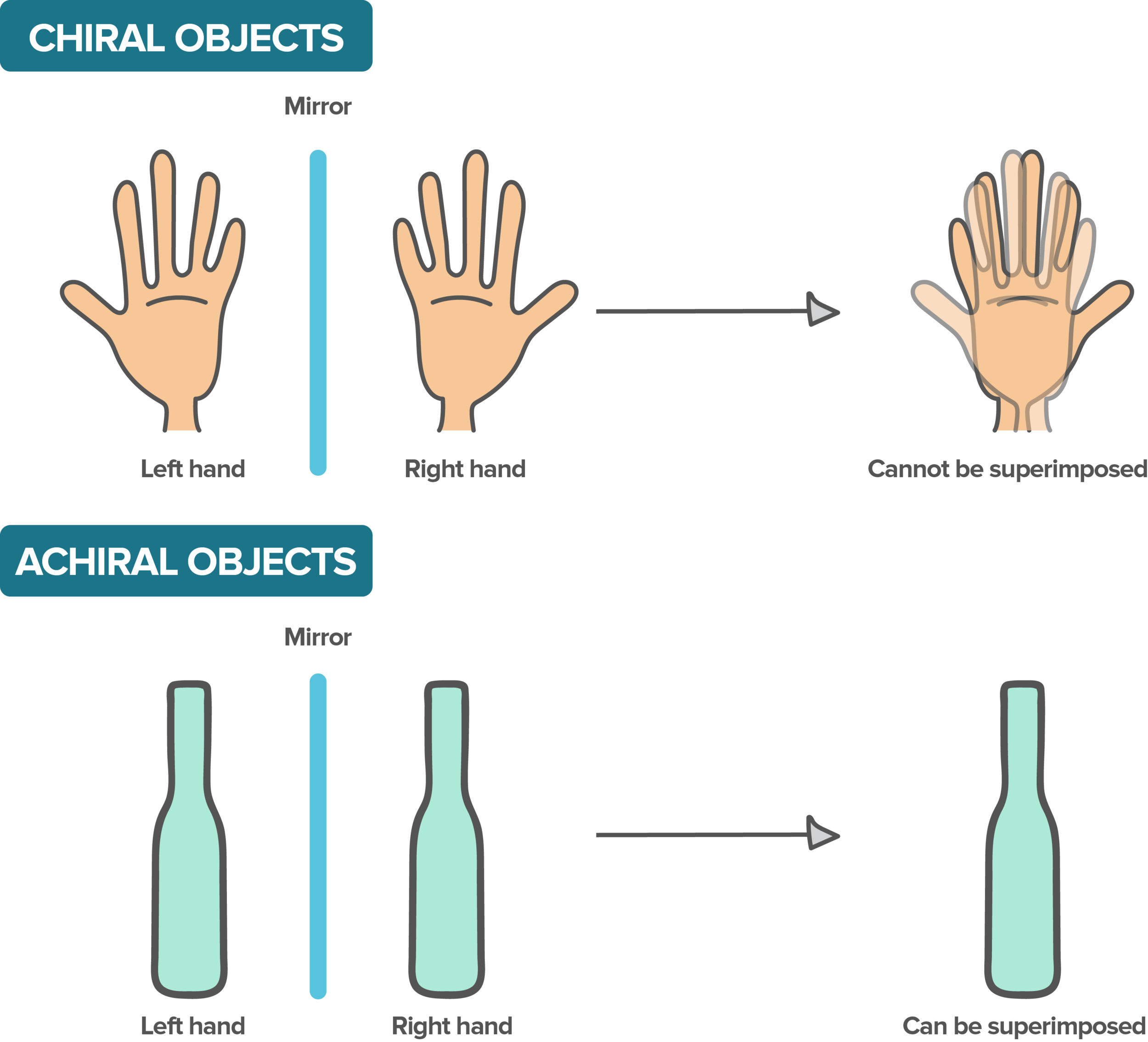
Chemists have a word for this, one I have been carrying for about twenty years now, long enough that it stopped feeling like chemistry and started feeling like a description of something I kept watching happen in the world, something we had been losing without a name for the loss. The word is chirality, from the Greek word for hand. It describes molecules that are perfect mirror images of each other and yet cannot be exchanged, cannot be made to do the same work in the same system, because fit depends entirely on orientation, on where something lands and what it is landing into, and the atoms carry no explanation for why, because the explanation lives in the relationship between the thing and its context, and nowhere else.
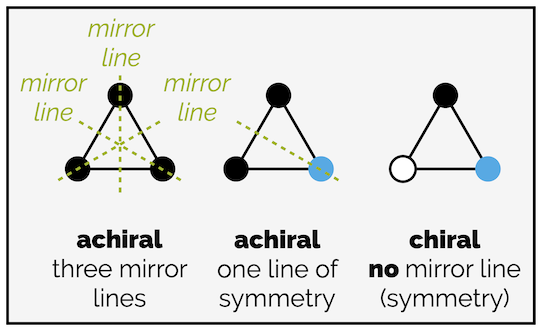
Chirality names a quality we have been systematically dismantling without ever stopping to ask what we were taking apart.
The Room
Every system that runs on people eventually develops a way of processing what those people actually feel, and the way it processes that feeling is almost always the same, which is to translate it into something the system can absorb without having to change. Maybe you have felt this in a company, maybe in a family, maybe in a school or a church or a relationship where you learned early that certain things could be said and certain things could not, and the things that could not be said were almost always the most important ones, the ones that would have required someone with power to sit with genuine discomfort rather than route the feeling into something more manageable.
There was a room I sat in many times, different buildings sometimes, different cities, but always the same room, the long table and the people around it who had been selected over years, through many small and large decisions, for their demonstrated ability to project certainty in the presence of uncertainty, a skill that becomes dangerous when it is the only skill the room knows how to reward. You could feel when someone almost said something true, a slight catching in the breath, a sentence that started in one direction and then quietly corrected its course before it could arrive anywhere that might require a response, and the feedback you had spent weeks writing, the kind that came from watching what was actually happening to actual people, would come back to you translated into a language whose entire purpose was to be absorbable, which is to say a language designed to move through the organization without catching on anything, without requiring anyone to change what they were doing or how they were seeing.
A system optimized for smooth replication will always and without malice convert genuine resistance into something it can process.
The system was not broken. It was doing exactly what it had been built, through years of accumulated choices about what to reward and what to remove, to do. A system optimized for smooth replication will always and without malice convert genuine resistance into something it can process, and real feedback is resistance, and vulnerability is resistance, and the particular irreducible texture of one person’s actual experience is resistance, and so the machine, not out of cruelty but out of its own evolutionary logic, quietly transforms all of it into something transferable, something that carries the shape of communication without the weight of it, and presents this transformation to everyone involved as progress.
What We Stopped Measuring
When we started calling content viral in the early 2000s we meant it as a kind of praise, as a description of something we wanted, reach and speed and the frictionless ability to move from person to person and context to context without losing anything essential in the transfer, and a viral video does in fact work the same way whether you are watching it in São Paulo or Stockholm, whether you are twenty-three or sixty, whether you are grieving or celebrating or somewhere in between, and that sameness, that perfect context-independence, is precisely and entirely what allows it to spread the way it spreads.
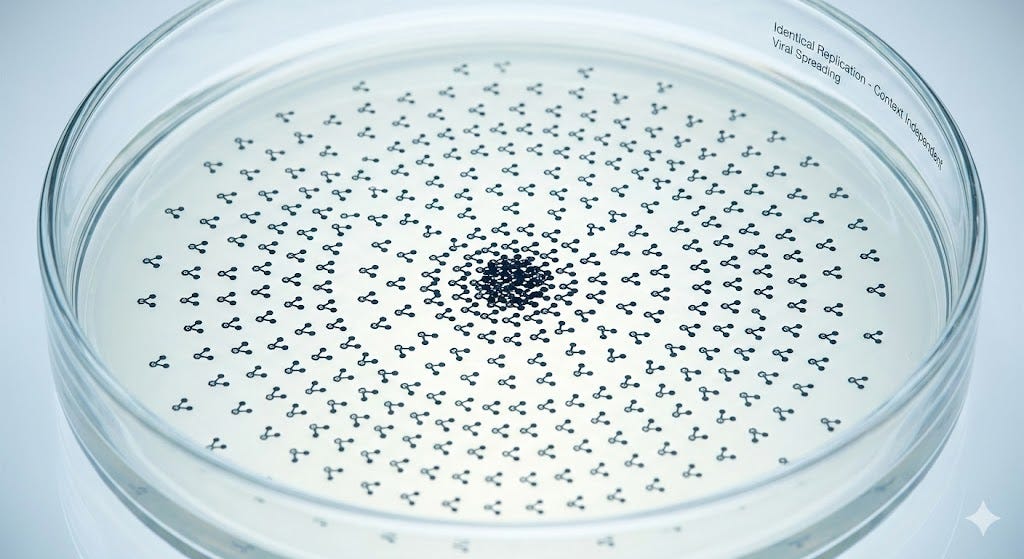
But look at the word we chose. A virus succeeds by making identical copies of itself in every host it enters, copies that carry no memory of where they’ve been, that do not adapt to local conditions or accumulate anything from the journey, that have no relationship to their host beyond the host’s usefulness as a medium for replication, and we watched this process unfold across platforms and feeds and recommendation engines and we called it beautiful, we called it a compliment, we built entire industries whose single organizing purpose was to understand how to make it happen faster and reach people at once.
We could have asked whether a thing changed the person who encountered it, whether a year later they were different in any way that mattered, whether it lodged somewhere in them and altered how they moved through the world. We measured copies instead, and we called the count success, and we optimized toward that count with tremendous ingenuity and resources over two decades, and we are only now, slowly and reluctantly, beginning to reckon with what the count was always silent about.
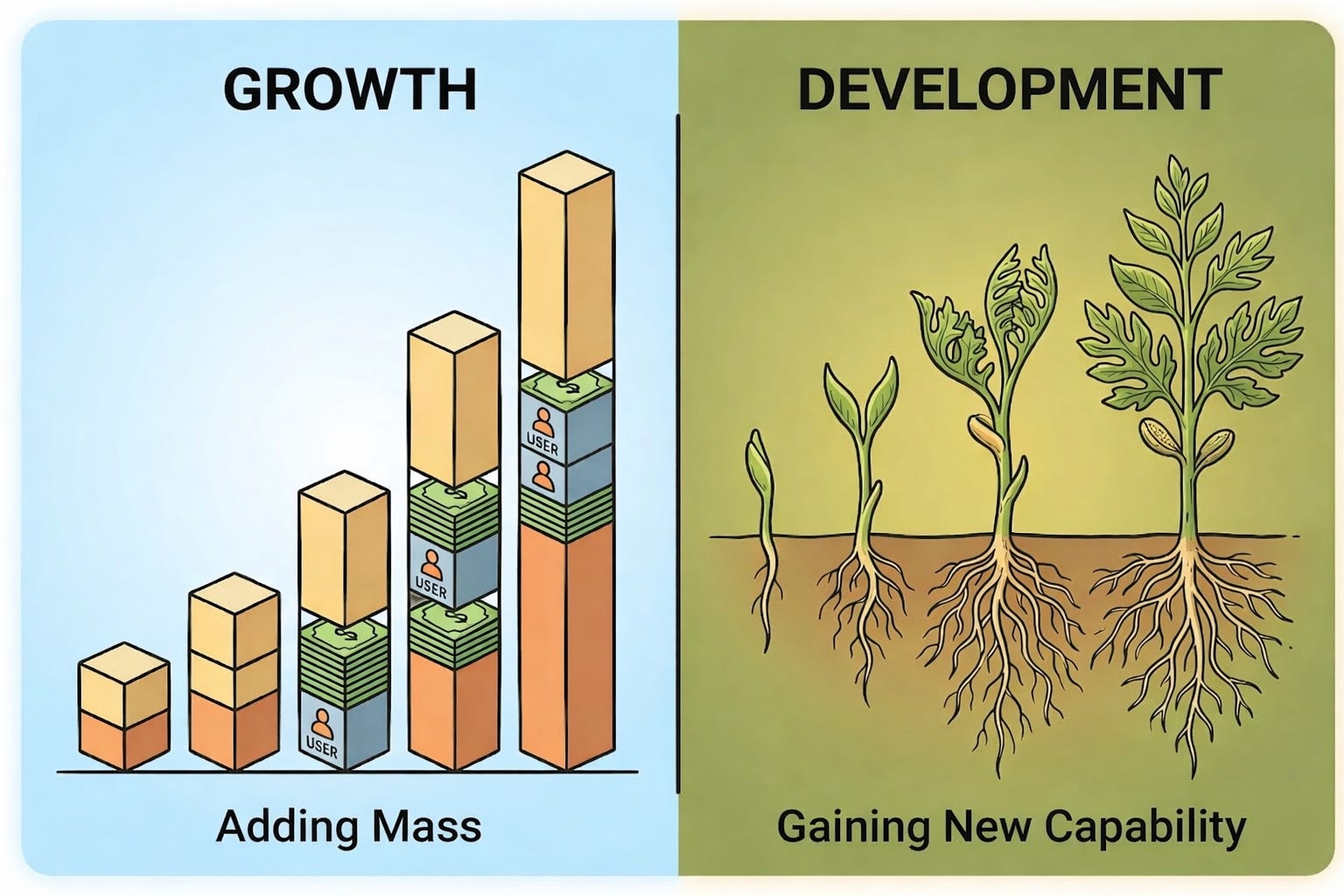
Growth and development are not the same word and they do not describe the same thing. What I watched over years inside a company that was profitable every one of those years was an organization that grew significantly and developed almost not at all, not because anyone there was unintelligent or indifferent but because the mechanisms that would have enabled development, the retrospectives and the documentation and the genuine willingness to hear what the people inside it were actually experiencing, had never been built, because building them was never what the metrics were designed to track, and so the same problems continued to present themselves to each new cohort of employees, forty to fifty percent of whom would be gone within the year, replaced by people who had not yet learned which questions it was safe to ask.
What Accumulates
Think about the last time you watched a video of someone suffering somewhere far away, because you have, we all have, it is one of the defining experiences of living inside the media environment we have built, and think about what happened in your chest when you watched it, the tightening that is real and involuntary and has nothing to do with whether you act on it or what you do with it afterward. That tightening is an old circuit doing what it evolved to do, firing in response to suffering the way it fires regardless of where you are sitting or who you are or what else is happening in your life, and there is nothing false about it, because the feeling is real, it is just not the only kind of feeling there is, and it is not the kind that builds anything.
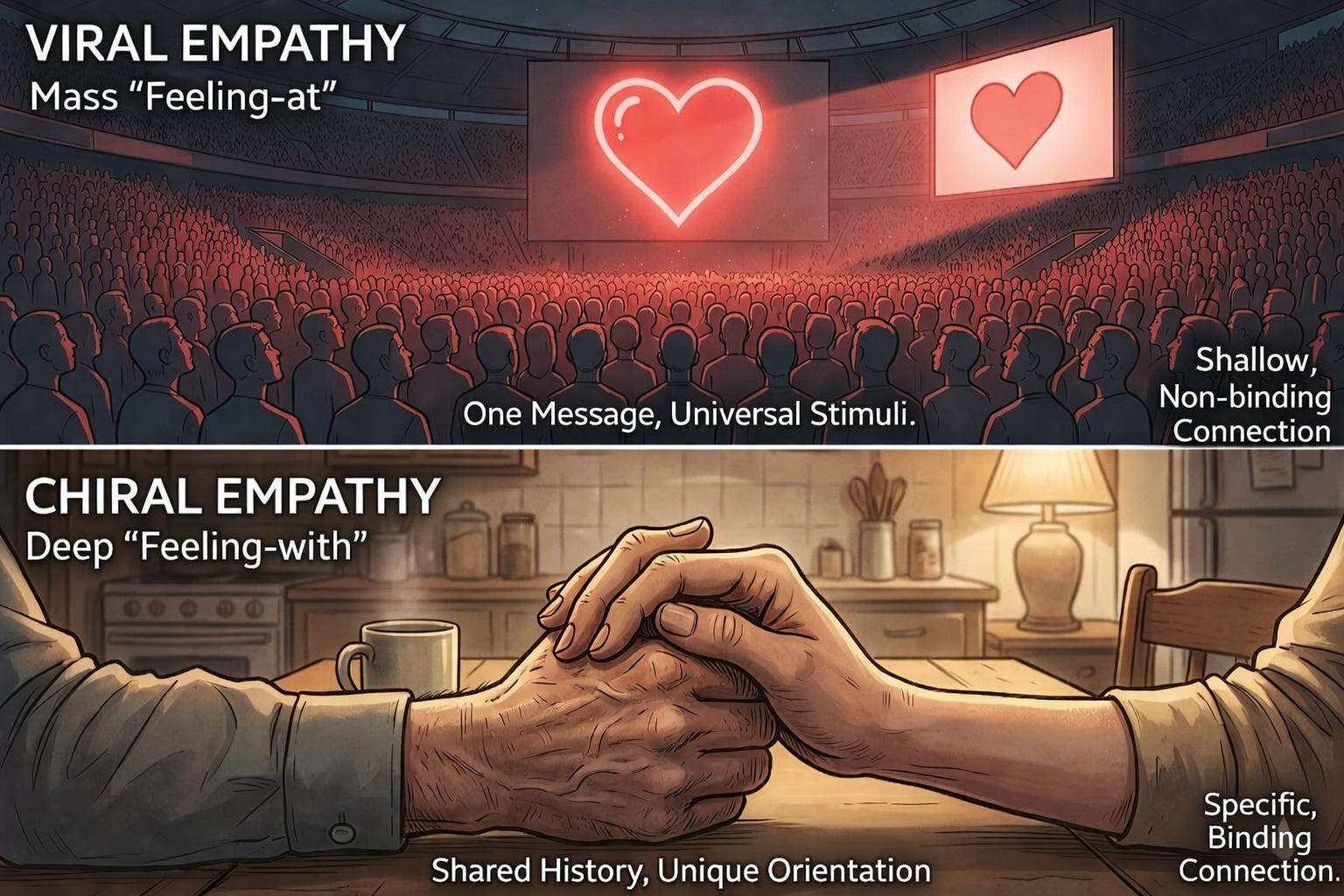
Now hold in your mind the last time you sat across from someone going through something genuinely difficult, someone whose particular history you know the way you know your own, whose previous losses you watched happen and whose way of going quiet when something hurts you have learned over years of sustained attention that could not be automated or abbreviated, and think about what you were able to offer that person that you could not have offered a stranger, not a function of how much you cared but of how much the relationship had accumulated, all the weight of shared time and specific knowledge that made your presence in that room something other than interchangeable, that made the handedness of the connection matter in a way that could not survive translation to any other pair of people because the fit lived in the history, and the history was not transferable.
The history was not transferable.
We have spent two decades building remarkable infrastructure for the first kind of feeling and watching the second kind quietly lose ground, and what we lost in that trade is not sentiment or nostalgia but the specific capacity to reach someone at the depth where things actually change, where a conversation becomes the thing you remember ten years later instead of the thing you forgot before you closed the tab.
Where Understanding Lives
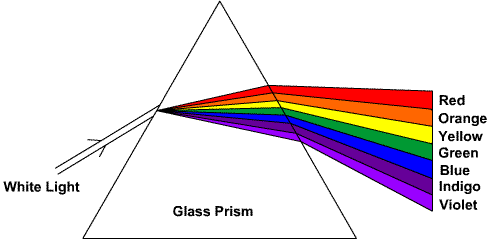
Consider what happens when you split light. A prism doesn’t create the colors inside white light, it reveals them, shows you that what looked like a single unified thing was always a mixture of frequencies traveling together, each one bending at a slightly different angle when it finally meets resistance, and what you get on the other side is not disagreement between the frequencies but simply the truth of what was always there, separate orientations that had been moving in the same direction without ever quite occupying the same space.
Human beings have been sorting the world into warm and cool, into advancing and receding, into the frequency that signals danger and the frequency that signals depth, for longer than any of us have been alive, and these are not arbitrary assignments, they are the accumulated weight of millions of encounters with fire and sky and blood and water, encoded so deeply into how we process the world that they feel less like learned associations and more like the structure of perception itself, and by the time any of us arrives at a conversation about anything that matters, we are already standing inside a mental model built from decades of frequency-sorting that the other person cannot fully see and we cannot fully explain.
It’s the Thanksgiving table where someone says something that seems perfectly reasonable to them, a comment about work, or fairness, or what the news said last week, and you feel the room shift in a way that has nothing to do with the words and everything to do with the frequency they landed on, and everyone adjusts, everyone finds the slightly safer version of what they were about to say, and the meal continues and nothing gets resolved because nothing was actually addressed, because what was in the room wasn’t really a disagreement about facts, it was two different orientations toward the world briefly becoming visible to each other and then retreating before anyone had to sit with the discomfort of that, and you drive home afterward carrying the particular exhaustion of a conversation that happened entirely on the surface of something much deeper.
The same thing happens in boardrooms, in product reviews, in the meeting where someone presents data that should be clarifying and instead the room splinters into people who see completely different things in the same numbers, not because anyone is lying or confused but because each person is reading the data through a mental model built from everything that came before this moment, the industries they grew up in, the failures they’ve absorbed, the particular way their last company collapsed or succeeded, and the data lands differently in each of those contexts the way light bends differently through different densities, and nobody names this, because naming it would require admitting that the shared vocabulary everyone is using is not actually shared at all.

We keep misdiagnosing this distance as a shortage of communication, but the feeds are already full, the arguments have already been made at length and at volume, the information is available to anyone who wants it, and the distance between people holding different orientations keeps widening anyway, which is what happens when you try to solve a handedness problem by increasing the volume of the broadcast, a mechanism that has never once been how two differently oriented things learn to fit together.
We built something that sheds them by design.
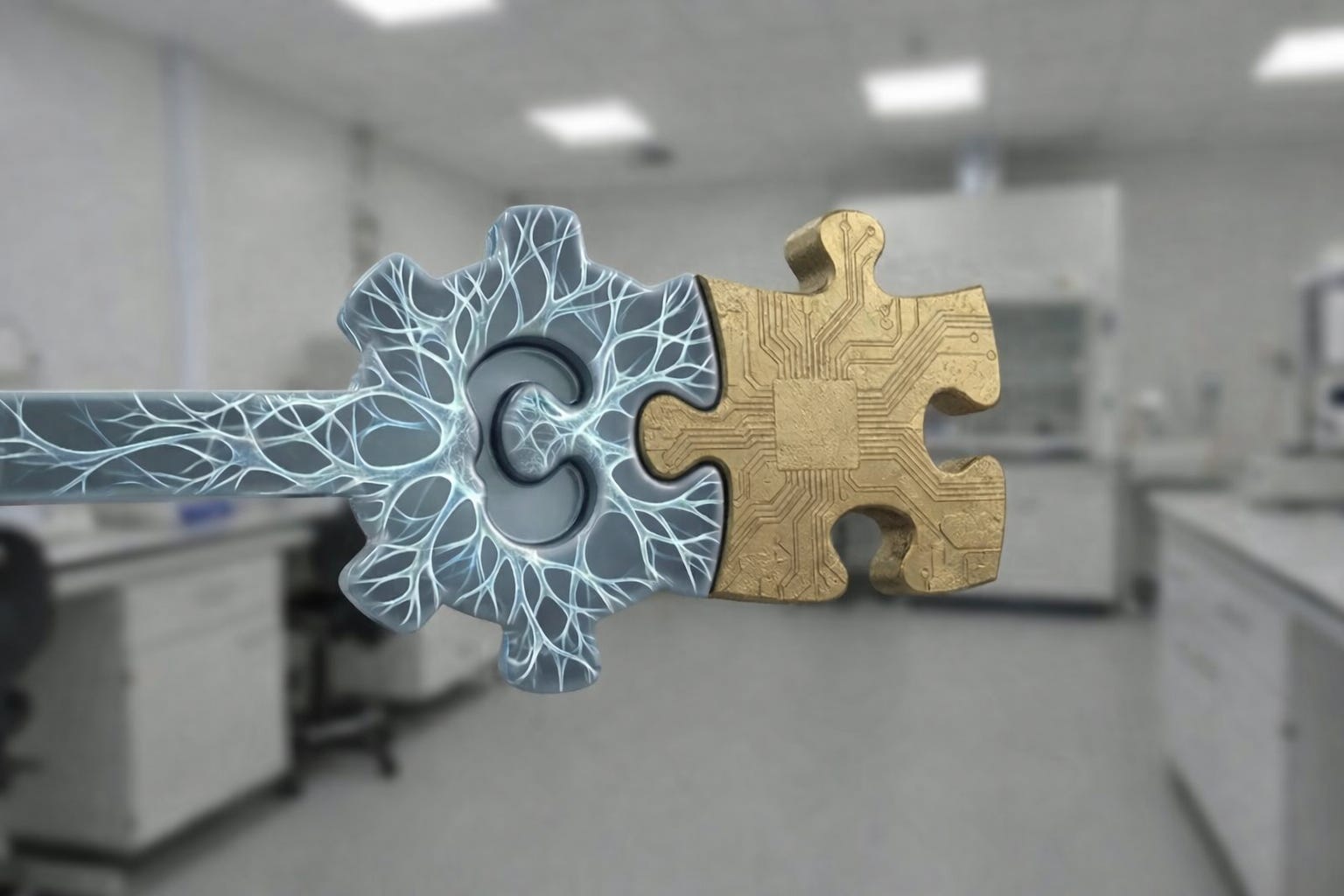
What has always been absent is translation, the kind that requires someone who understands both frequencies well enough to carry the actual substance of what each is trying to say across the gap without flattening it into a gray that neither side recognizes as theirs. Translation asks you to preserve the original and make it legible to someone whose handedness is different, while compromise only asks both sides to accept less. We have been selecting against the people who know how to do it because that skill requires exactly the kind of tolerance for resistance that the systems we have built were designed to eliminate, and the tragedy of optimizing for virality is that content traveling without mutation across every context must shed its local particulars, and the local particulars are exactly where the possibility of real understanding lives. We built something that sheds them by design.
If you'd like to support the project, you can contribute to the 451 Firewall Fund. Read the full collection on Substack and Medium. The companion project lives at helloyouexperiment.com.